The Long Middle
On Creativity as Relationship with Life. A reflection on gardening, artmaking, and the long often invisible middle where creativity unfolds as a relationship with time, experience, and connection.
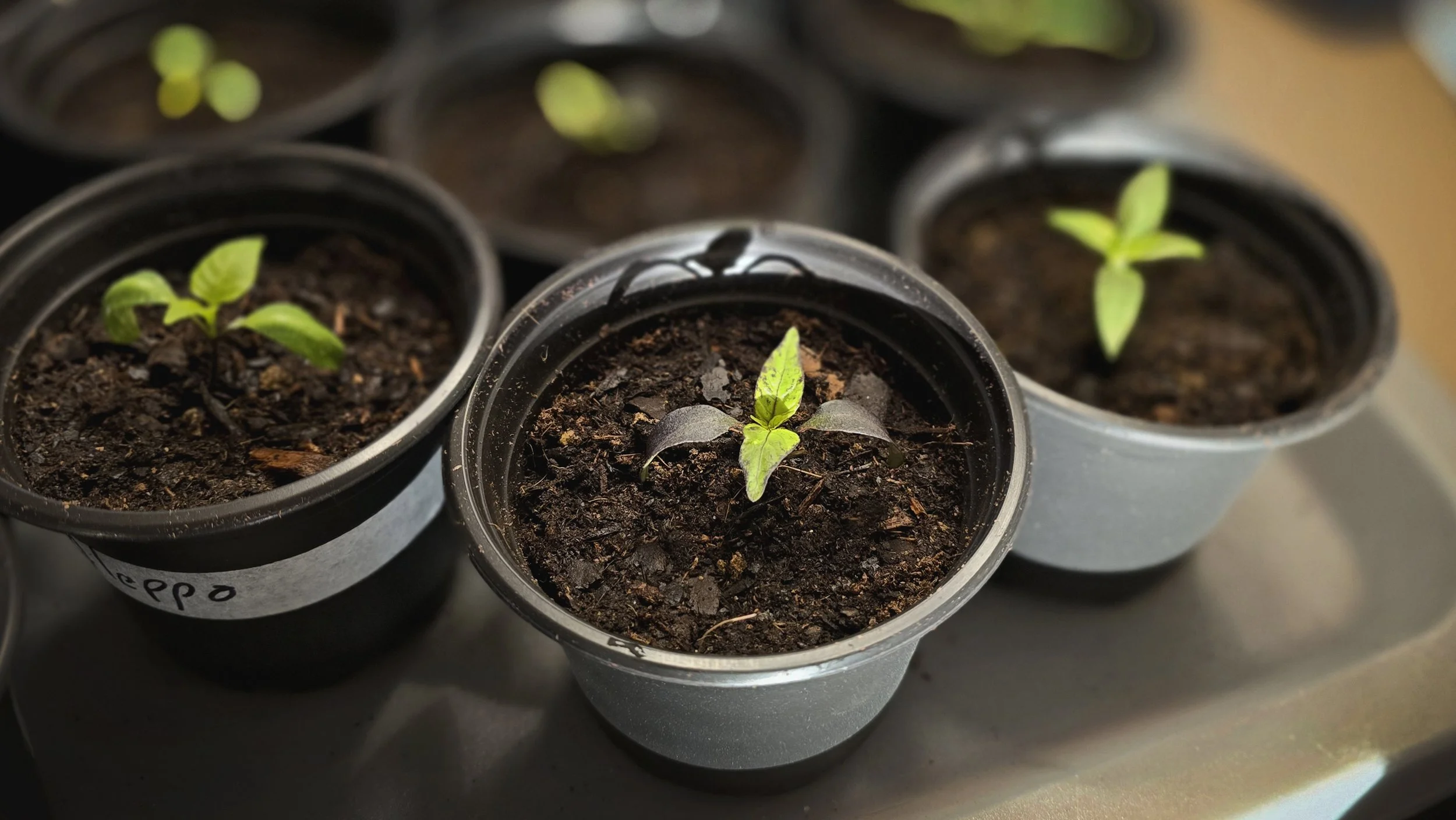
This week I transplanted seedlings, and I report this with unrestrained, slightly ridiculous enthusiasm. They are tiny peppers, basil, lettuce, and cilantro plants, barely more than two leaves with thin green stems, and I was excited to be moving them from one small container into another slightly larger container.
It really isn’t all that complicated. You loosen the soil just enough to free the roots without tearing them (I used a spoon) and lift the plant free. You make space in new ground. You press the dirt back in around it, so it stands upright again.
To be fair, it’s hard to make that moment impressive, and it’s probably not what most people picture when they hear the word creativity. After all, even in gardening terms, there’s no fruit yet. No color, no payoff. Just dirt, hands, and a few fragile leaves that won’t bear anything for months to come.
“In gardening and in artmaking, there is a subtle cost to isolating the fruit. When we define creativity by the visible peak (the finished painting, the published book, the viral post, the basket of peppers) we begin to measure ourselves by harvest alone.”
And there is a way of thinking about creativity too that would skip this part of the process entirely. It would wait for the harvest, bright red peppers, bushel baskets full. You know, the photographable results. It would call that the creative moment.
But, if we slow things down, we must admit the fruit is only one moment in a much longer cycle.
These small seedlings will grow slowly. If all goes well, they’ll produce peppers in late summer. Then those peppers will be dried and ground into paprika, and that paprika will sit in a jar in the kitchen until winter, when it will be sprinkled over deviled eggs at a holiday table. Family and friends will eat and talk and laugh. Months later, the plants themselves will be composted, and seeds will be saved for the next year.
To name it seedling, or pepper, or paprika, or even family connection, all of these are incomplete. It is soil and water and waiting. It is sunlight and insects and pruning and patience. It is a meal and a memory and a return to ground. And somewhere in these cycles, I am changed too.
Creativity, as I experience it, behaves very much like this. To define it or identify it with tangible work, with skills mastered, or even with practice and process is equally problematic. Creativity is a kind of agreement to enter into relationship with something living and to stay with it long enough for transformation to occur.
In gardening and in artmaking, there is a subtle cost to isolating the fruit. When we define creativity by the visible peak (the finished painting, the published book, the viral post, the basket of peppers) we begin to measure ourselves by harvest alone. After which, in the middle of the season, when there is only dirt and effort and no visible result, it becomes easy to conclude that nothing creative is happening.
Most of the creative cycle is invisible. It is ideas and feelings spreading underground, small adjustments of trajectory, and patience in the absence of applause. It is accepting that some seasons will bear less fruit than others (or none at all), and that “compost” isn’t failure but a vital part of the process of life.
Creativity is a way of being in relationship with life, with materials, with time, with uncertainty, with the deeper current moving through it all. The more that relationship is tended, the more fruit it bears, sometimes in the form of peppers and paprika, sometimes in the form of paintings or books or conversations, sometimes in the form of meaning itself. And sometimes simply in remembering that whatever unfolds this season, another one will follow.