A Tale of Time (Management)
Or How my Mayura Journal is Holding the Space. This week, I realized that nearly everything I’ve built over the past five years grew out of one small journaling experiment.
This week I’ve been working on building out the Get Creative section of the Mayura website, which will house some new offerings, including one-on-one “Studio Hours” sessions and access to creative support. As the structure of the site unfolds, it’s continuing to do something I didn’t fully anticipate. Namely, it keeps making the entire Mayura system more visible and accessible—hopefully to others, yes, but somewhat surprisingly, even to me.
This week’s unexpected gem was realizing that literally everything Mayura (and my entire existing creative process outside it) grew out of what I’ve come to call my own “Mayura Journal.”
What surprised me wasn’t that the journal shaped my creative work over the last five years, but just how deeply embedded it is across … well, everything. It’s been so integrated into my daily life and creative work that, on some level, it became almost invisible. I’ve been building Mayura, developing ideas, creating work, and structuring my time through that process for years, and yet, somehow, it was one of the last studio methods to be named directly.
All of that had me reflecting on what exactly the Mayura method of journaling really is and how it came to be. Like most things around here, that’s a story.
“When we try to impose order onto our lives, we tend to assume the problem is our own lack of discipline. If anyone has ever actually gotten it together that way, please feel free to let me know.”
The Tale in Question
Back in 2020, while COVID was reshaping the world, I took the first step toward transitioning out of full-time nonprofit work. I became a self-employed, part-time contractor, which freed up about half of my normal working time. It also meant I was suddenly staring at a newly acquired, amorphous blob of unstructured time.
I had no clear sense of what I wanted to build, and I intuited that without some kind of structure, most things would drift into “great idea, I’ll do that later” territory—which we all know (even without testing it) means it will live in “becoming” perpetually.
So I did what I often do. I researched how people manage their time—and how they figure out what they want to do with it. Somewhere in all of that, I kept hearing people talk about how much they rely on their planner systems and how much insight they gain from journaling. Both of those seemed like good ideas. I also knew myself well enough to know I had never successfully kept up with either.
That’s when I decided to run an experiment.
I gave myself one question to answer in the morning and one question to answer at night. That was the entire requirement. The process had to be portable, simple enough to do from anywhere, and easy enough that I couldn’t talk myself out of it. For fun, I gave each page a small icon: a sun for morning and a moon for night. That was it.
From there, I iterated. And the system grew.
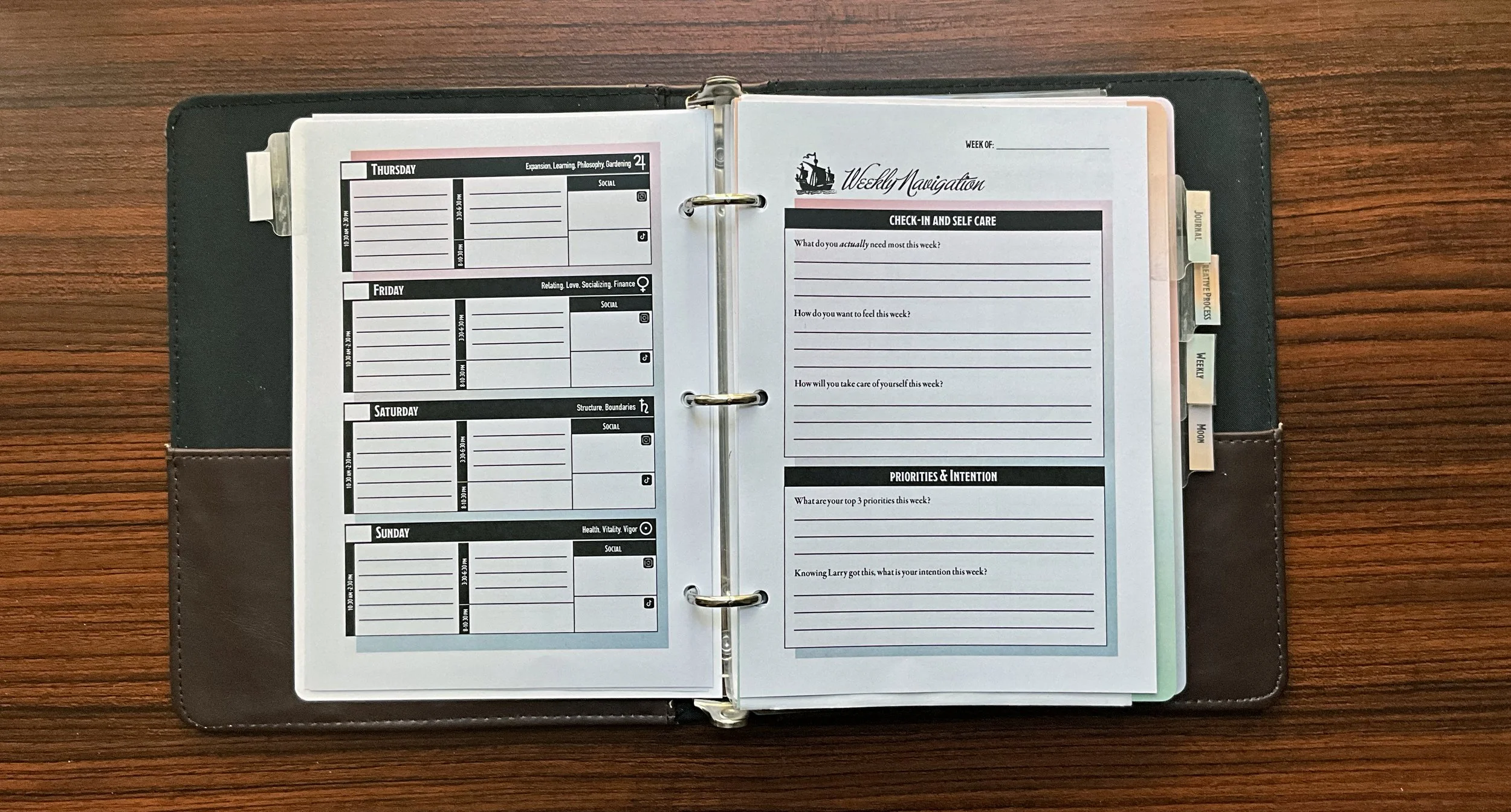
I discovered that I could answer those two questions every day. And based on those answers, I adjusted the system and reset the experiment. Slowly, over the years that followed, that small iterative structure expanded to include time navigation, sketch space, project tracking, daily reflections, garden management, holiday logs, and personal resources (just to name part of the map).
The pages, the questions, and the system changed, regularly. What remained constant was the practice of writing, reflecting, adjusting, and writing again.
What has become clear to me over time is that this is a skill we are rarely taught.
By the time we reach adulthood, we’re masters of other people’s systems—at school, at work, in our families, and even through the many tools designed to help us organize our time and our lives.
But very little in our day-to-day experience asks us to use our creativity to design systems that actually reflect our own choices and needs. It’s little wonder that doing so can feel nearly impossible.
When we try to impose order onto our lives (we’re all looking at you, beautiful unused planner), we tend to assume the problem is our own lack of discipline. “I just need to get it together,” we tell ourselves.
If anyone has ever actually gotten it together that way, please feel free to let me know.
Looking back on my own small experiment—with a view of its five-year results—adds more evidence to something I had already suspected, a lesson I first encountered in the Adaptive Leadership classroom. There’s a phrase often repeated there: “People only support what they help create.”
I saw that principle play out consistently in organizational settings, and I’ve witnessed it on the individual level just as often. Systems that engage the personal, creative presence of their designers tend to be maintained, not because of discipline, but because they were built to meet the needs of their creators. And because their continuation actually matters to those who created them.
That level of engagement changes the relationship entirely.
I suppose what struck me this week wasn’t just the fruits of my own journaling approach, but the relationship I now have with it.
This week alone, I have used it to track the garden, review previous holidays and plan for upcoming ones, manage ongoing creative projects, sketch early work, navigate and re-calibrate my time, plan meals, and reference resources I’ve developed for myself over the years.
All of those things now exist inside my journaling “container,” so seamlessly that I often forget there was a time I didn’t have it.
Somehow, one small repeatable intervention, carried forward and adjusted over time, became a way of organizing not just tasks, but attention, decisions, and direction. It became a way of actively responding to life, instead of just attempting to manage it.
Don’t get me wrong, I still feel like there aren’t enough hours in the day. These days, though, that’s because those hours are filled with the things I wanted to be doing when I first started that small experiment.
Instead of wondering how whole days, weeks, and months are disappearing without progress, I now know exactly where my time is going. When it takes me a month longer than I want to get Studio Hours open, I know why. It’s because I’m over here laying plans for a new garden, taking on an unexpected design project, or making sure the system accounts for things like sleep and sunlight. And I know I chose all of those things intentionally.
In other words, authoring the system myself has made me the captain of my own life’s ship.
Some days that feels empowering.
Other days require… compromise, patience, and a good sense of humor.